
157 Commits: Our Website's Engineering and Codex Usage Audit
A documented audit of 157 website commits: estimated design hours, recorded Codex runtime, chat and token counts, revisions, and reusable workflow skills.
Product perspective
Workflow Automation Hub
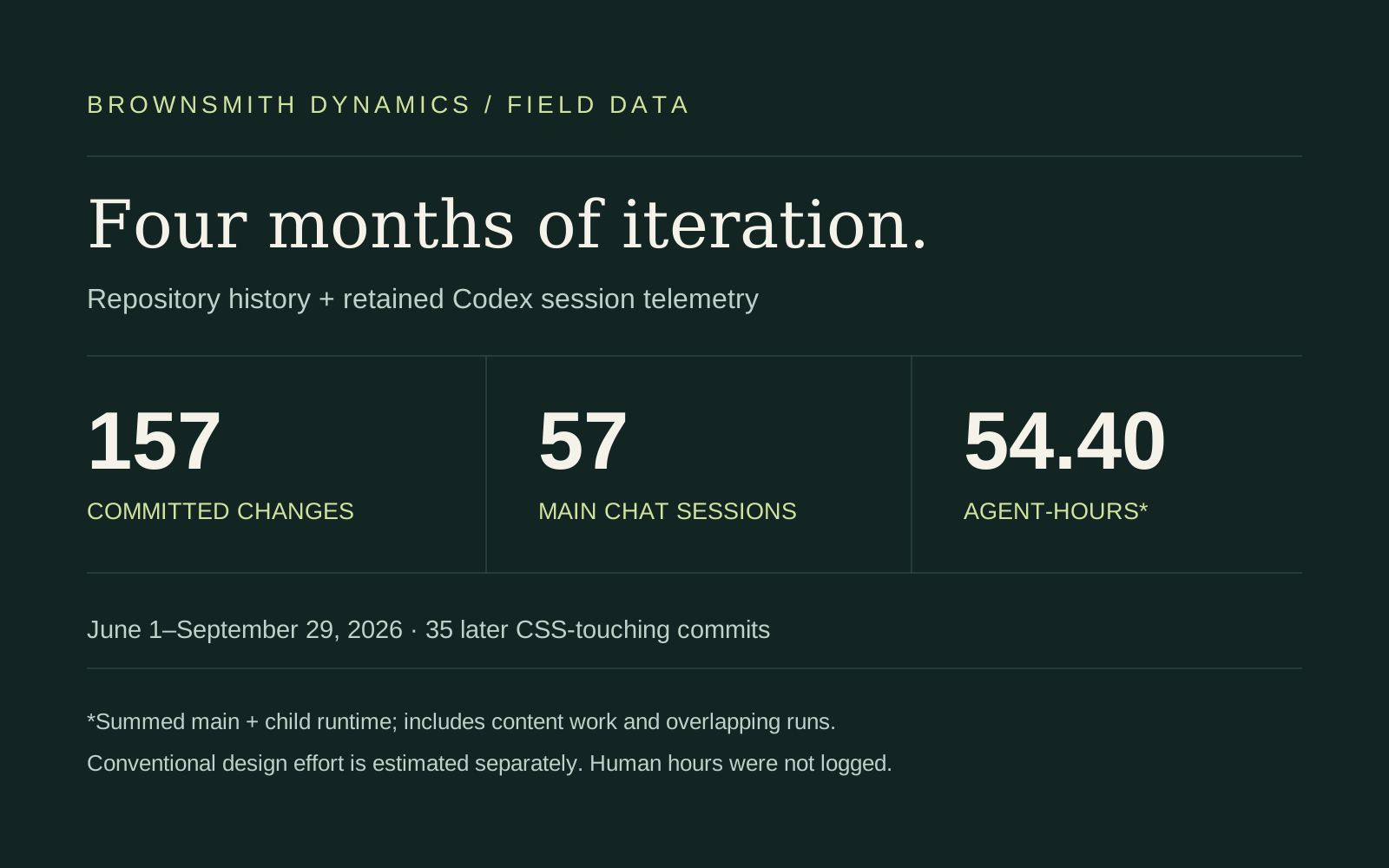
Between 1 June and 29 September 2026, the Brownsmith Dynamics website accumulated 157 commits. Retained Codex logs for the same repository contain 57 main chat sessions and 128 child-agent sessions. Completed main and child runs add up to 54.40 agent-hours; after overlapping intervals are merged, they occupy 44.42 hours of recorded activity.
Download the aggregate evidence and calculation notesWe estimate the custom web-design workload at 145–250 conventional person-hours, or 260–455 hours when supporting website engineering is included. Content generation is excluded from those estimates. The usage figures cover all recorded activity in the repository, including content work, and do not record our hands-on hours. The figures below keep these scopes separate.
Recorded scope
157 commits across a 121-date audit window
The audit covers 1 June through 29 September, inclusive: 121 calendar dates, not 121 working days. It ends at the last committed version before September 30. The first commit establishes a Next.js template; the next imports an earlier project's files. Both are part of the history, but neither is treated as custom work created from nothing. Uncommitted September 30 changes and this article's own production are excluded.
The Git history and session logs are private. We publish aggregate results and extraction rules instead of transcripts. A session qualifies when its recorded working directory matches this repository exactly, its start falls inside the window, and its counted events precede September 30 at midnight in India. The available logs span the window; that does not establish complete retention of every historical interaction.
| Category | Sessions | Counted as main chats? |
|---|---|---|
| Main agent | 57 | Yes: retained main session records |
| Child agents | 128 | No: delegated work |
| Approval reviewers | 306 | No: permission checks |
| All categories | 491 | Not 491 human conversations |
Estimated labour
145–250 design hours; 260–455 engineering hours
We grouped the custom implementation and substantial revisions into six workstreams. The counterfactual is a competent developer or small team using the same template, imported foundation, framework and component libraries, without generative AI. The ranges are audit-based planning estimates, not timesheets, market averages, quotations or confidence intervals.
Initial implementation and feature-level review belong to their workstream. Later device-specific corrections belong to responsive iteration; integration checks and route migrations belong to the final row. This boundary reduces double counting, but a finer task breakdown could still revise the allowances. The estimate covers historical iteration; rebuilding only today's final website would be a different scope.
Article prose, lesson content, catalogue descriptions, marketing copy, off-site publishing and image generation receive no hours in this model. A blog template counts as engineering; the article inside it does not. At eight hours per person-day, the design subtotal is about 18–31 person-days and the broader total about 33–57. These are labour equivalents, not delivery schedules.
| Workstream | Estimated person-hours |
|---|---|
| Visual system, shared layouts, navigation and footer | 55–90 |
| Marketing, product and service templates and journeys | 55–95 |
| Responsive, accessibility-related and visual revisions | 35–65 |
| Design subtotal: the three rows above | 145–250 |
| Quiz, directory discovery and course interfaces | 55–95 |
| Technical SEO, performance, analytics and consent | 35–65 |
| Integration checks and route migrations | 25–45 |
| Broader total: all six workstreams | 260–455 |
Observed runtime
54.40 agent-hours and 44.42 hours after overlap
For each completed turn, we use the recorded duration and start/completion interval, deduplicated by turn identifier and agent category. Main-agent runs sum to 45.86 hours; child runs add 8.54. Approval reviewers add 1.55 hours separately. Summing concurrent runs measures aggregate agent activity. Merging intervals across main and child runs gives 44.42 hours with at least one recorded run active.
This is the closest available record of Codex hours used. It includes model generation, tool execution and waiting inside completed runs. It omits uncompleted runs and human work between turns. It also includes editorial and external-channel tasks performed from this directory. No design-only runtime total is claimed, and dividing the conventional design estimate by 54.40 would not produce a matched productivity comparison.
| Category | Completed turns | Summed hours | Hours after overlap |
|---|---|---|---|
| Main agent | 454 | 45.86 | 44.09 |
| Child agents | 158 | 8.54 | 4.71 |
| Main + child | 612 | 54.40 | 44.42 across both categories |
| Approval reviewers, separate | 1,244 | 1.55 | 1.55 |
Interaction volume
621 user-message records and 509 final answers
In the 57 main sessions, the retained response records contain 621 user-role messages, 509 assistant final answers and 2,390 assistant progress messages. Main-agent visible answer/progress records therefore total 2,899. Tool calls, reasoning text and approval-review answers are excluded from that response count.
We deduplicate by role, original timestamp and a hash of the message text, and exclude AGENTS instructions, environment snapshots and empty open-page updates. User-role records can include automated or delegated inputs; 621 is not a certified count of manually typed prompts. Message records and completed-turn events are different log objects, so neither the 509 answers nor the 621 inputs should be forced to equal the 454 completed main turns.
| Message category | Main | Child | Approval review |
|---|---|---|---|
| User-role inputs | 621 | 283 | 1,447 |
| Assistant final answers | 509 | 232 | 1,440 |
| Assistant progress messages | 2,390 | 127 | 0 |
Local usage estimates
Token volume includes repeated and cached context
The token estimate sums positive changes in cumulative usage counters. Earlier inherited history establishes a baseline rather than being counted again; identical counter transitions are deduplicated. When a cumulative total falls, we begin a new counter segment. Fourteen such resets appear across the retained categories. These are local telemetry estimates, not a reconciled account or billing export.
Main and child activity together records an estimated 1,685,853,765 input-plus-output tokens. Of the 1,680,245,328 input tokens, 1,614,669,056 are marked cached: 96.10%. The remaining input is 65,576,272 tokens. Output totals 5,608,437 tokens, including 1,552,730 marked reasoning output. Cached input and reasoning output are subsets and are not added to the total again.
The large input number reflects context processed repeatedly across calls; it is not 1.68 billion words written or unique information supplied. Content, research and engineering share this usage scope. Token totals do not establish cost without validated model-specific pricing and billing treatment, and cannot be converted into person-hours.
| Counter | Main | Child | Main + child |
|---|---|---|---|
| Input | 1,498,722,933 | 181,522,395 | 1,680,245,328 |
| Cached input, included above | 1,442,022,784 | 172,646,272 | 1,614,669,056 |
| Output | 4,715,878 | 892,559 | 5,608,437 |
| Input + output | 1,503,438,811 | 182,414,954 | 1,685,853,765 |
Recorded iteration
35 CSS-changing commits, 8 copy commits, 6 positioning milestones
Across the history, 37 commits touch tracked CSS. Removing the initial scaffold and first custom draft leaves 35 later CSS-touching commits. This is a reproducible styling proxy, not a count of complete redesigns: JSX-only styling is missed, and CSS refactors may not visibly change the design. Examples of wider redesign work include June 23's visual revision, July 26's landing-page redesign, September 10's typography/service redesign, and September 25's outcome-focused landing rewrite.
We also inspected eight clearly identified marketing-copy revision commits: June 15 twice, June 18, July 11, July 31, September 2, September 15 and September 29. Article and course writing are excluded. This conservative list does not count every text edit inside mixed feature commits.
Six inspected positioning milestones changed audience emphasis, service presentation or the relationship between the homepage and supporting pages. We publish their count and classification without reproducing internal strategic discussions. They are six recorded positioning iterations, not six independent strategic pivots. The categories overlap; they cannot be summed into 49 separate work packages.
| Measure | Count | Definition |
|---|---|---|
| Post-draft CSS-touching commits | 35 | 37 CSS commits minus 2 initial build commits |
| Identified marketing-copy revision commits | 8 | Explicit copy subjects confirmed against diffs |
| Positioning milestones | 6 | Selected direction-bearing changes confirmed against diffs |
Reusable workflow assets
Two documented editorial skills and eight relevant capabilities
The repository's editorial rules require write-progressive-article for structure, sources, metadata and publication state, followed by humanize-writing for the final editorial pass. Both were applied to this article. They have no measured hour or token saving in this audit.
Our Apnatva Skills collection lists 13 top-level skills. The founder reports that ideas from this website's work inspired the collection. Its files document the capabilities below; the origin is founder-reported, and this audit does not claim that all eight were invoked during the historical build. They are procedures that can improve repeatability, not eight additional development tools whose individual impact has been measured.
| Skill | Useful application |
|---|---|
| Marketing and Persuasive Writing | Audience, positioning, proof and objection-led copy |
| Company Voice | Persistent voice, claim status and editorial memory |
| Marketing, Behavior, and Design Frameworks | Explicit frameworks for UX and persuasion decisions |
| Next.js Optimisation | Rendering, performance, accessibility and technical SEO |
| Website Analysis | Repository, messaging and implementation audits |
| Website SEO Guardrails | Indexing, structured data and repeatable checks |
| SEO + AEO Visibility Strategy | Site-specific search visibility priorities |
| Concise Communication | Shorter output while preserving facts and meaning |
Sensitivity calculation
Estimated savings depend on unrecorded human hours
We have no human timesheet. The table therefore assumes 40, 80, 120 or 160 total assisted person-hours, including prompting, design decisions, review, manual edits, testing and rework. The ratio is conventional design hours divided by assumed assisted human hours; reduction is one minus assisted hours divided by conventional hours. These scenarios are not inferred from the 54.40 agent-hours.
External research supplies context rather than a replacement denominator. The OECD's 2025 SME survey reports reduced workload for about one third of generative-AI users. A 2023 Copilot experiment reported 55.8% faster completion on a JavaScript HTTP-server task. METR's 2026 follow-up explicitly identifies selection and concurrent-agent timing problems. None measures this website's savings.
| Assumed assisted person-hours | Conventional / assisted | Modelled labour reduction |
|---|---|---|
| 40 | 3.6–6.3× | 72–84% |
| 80 | 1.8–3.1× | 45–68% |
| 120 | 1.2–2.1× | 17–52% |
| 160 | 0.9–1.6× | −10% to 36% |
Conclusion
The documented totals, without an invented speedup
The audit records 157 commits, 57 retained main chats, 621 user-message records, 509 final-answer records and 54.40 summed main/child agent-hours. Its conventional effort model estimates 145–250 design person-hours and 260–455 broader engineering person-hours. Those are the numbers we can publish with their definitions. Human hours saved remain a scenario, not a measured result.
The downloadable evidence includes aggregate counters, dated revision categories and calculation rules. It omits private prompts, session identifiers, machine paths, commit identifiers and internal commit messages. Readers can inspect the methodology while the underlying repository and transcripts remain private.
Reusable procedures
Browse our agent skills
Explore the documented writing, website analysis, SEO and workflow capabilities behind the skills collection.
View agent skillsBusiness efficiency
Measure a workflow in your business
Define a baseline, acceptance criteria and review effort before estimating the benefit of automation.
Explore business efficiencyResearch notes
Sources and Supporting Material
These references support factual claims in the article. Brownsmith's interpretation and forward-looking analysis remain editorial judgement rather than vendor promises.