A manufacturing website should help buyers assess fit before they enquire
How an SME OEM/ODM manufacturer website connects capabilities, catalogue requests and contact forms to help buyers assess supplier fit before an enquiry.
A buyer looking for a manufacturing partner is trying to answer a practical question before starting a conversation. Can this supplier make the kind of product or component I need, at the level of development and production support the project requires? A website helps when it gives the buyer enough evidence to make that first assessment.
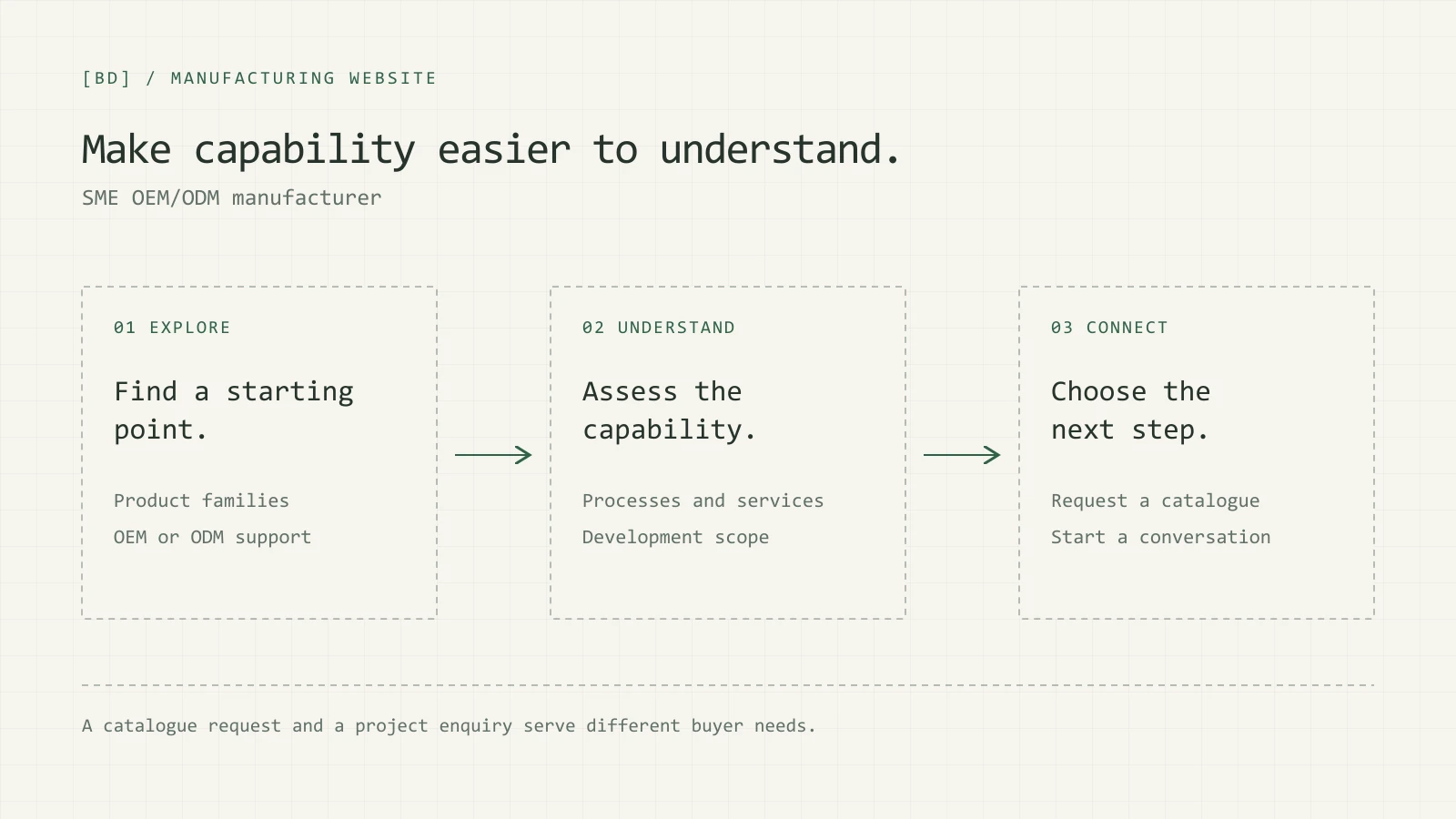
Read the SME OEM/ODM manufacturer website case studyThat means translating factory expertise into a route a buyer can follow. Explain capabilities in plain terms, connect them to products or applications, make the catalogue useful, and show what to include in an enquiry. The site should make the next conversation more informed, not ask a buyer to assemble the picture from scattered claims.
A recent SME OEM/ODM manufacturer website provides a useful example. Its pages group manufacturing processes, products and business models, then offer a catalogue request and direct contact routes. The work illustrates how those pieces can support supplier assessment. It does not establish a measured change in enquiries or sales.
Make Supplier Fit Easier to Assess Before Contact
A purchasing or engineering team rarely arrives with one question. They may need to know whether a supplier handles a specific process, supports product development, can build to a drawing, or has experience with a particular material or finish. A generic claim such as “end-to-end manufacturing” does not answer those questions. The buyer still has to ask what the phrase covers.
An effective manufacturer website gives those questions a place to land. It names the processes and products the business handles, explains the work around them, and shows how a project could move from an initial brief toward production. Buyers can then compare the supplier’s stated scope with their own needs before committing time to an enquiry.
This is a content and navigation problem as much as a visual one. Content Marketing helps turn operational expertise into explanations a buyer can use. If capabilities live in one long page, products in a catalogue, and contact details in the footer, visitors must keep the connections in their heads. A clear structure carries those connections for them.
Describe Capabilities in the Language of a Project
Factory teams often describe work through equipment, process controls and internal departments. Those details matter, but a buyer needs to understand what they mean for a product. A page about injection moulding, for example, can explain the kinds of components it supports, the production range the business can substantiate, and the quality controls relevant to repeatability. A fabrication page can connect cutting, forming or welding to the parts and assemblies those processes serve.
A useful capability page moves from the buyer’s application to the process, then to the evidence. It can name machine ranges, materials, tolerances, finishes, tooling support or inspection steps where the company has approved information. Specifics help the right buyer recognise fit. They also make limits easier to see, which saves both sides from pursuing a project the factory is not set up to deliver.
On the SME manufacturer site used here, service pages present distinct process areas, while related product and business pages add context. The current material includes process descriptions and certain capacity details. Those facts are source content, not a template for every manufacturer. Any new site should publish only figures and capabilities its operations team can verify.
Explain OEM and ODM as Different Starting Points
OEM and ODM are useful terms, but buyers can use them differently across sectors and contracts. Define the model the business actually offers instead of assuming the acronym will carry the explanation.
In a typical OEM arrangement, the buyer brings the product definition, design or specification, and the manufacturer produces to the agreed requirements. In an ODM arrangement, the manufacturer contributes an existing or developed product design or platform, while the buyer may select options, apply its brand or request agreed changes. The precise division of design ownership, tooling, compliance and production responsibility belongs in the commercial agreement.
A website can make the distinction legible with two short explanations and concrete examples of the information each route needs. An OEM enquiry might include drawings, target materials, expected volumes and inspection requirements. An ODM enquiry might identify the product category, desired configuration, market and branding needs. These prompts help buyers choose a starting point without turning the website into a substitute for technical review or contract terms.
Make the Catalogue and Enquiry Path Work Together
A catalogue is useful when it helps a buyer compare relevant products. That calls for readable product names, specifications that matter to selection, clear categories, and a way to move from a product to its related manufacturing capability. If a catalogue is available only after a request, the site should explain what it contains and why the buyer is being asked for contact details before opening the form.
The case study site provides an example of a request-based catalogue flow. Its page tells visitors that the document contains products, specifications and ordering details, then asks for name, email and phone information. The catalogue validates those details in the browser, then submits them through a dedicated server route to Google Forms. The general contact form adds a short message and applies server-side name, email, Indian phone number and message checks. The message is limited to 10–200 characters, making it an initial contact rather than a detailed technical brief. A manufacturer considering a similar gate should decide whether those fields are needed for the follow-up it intends to provide. A browsable catalogue may serve early-stage buyers better when the products and specifications can be shared openly.
The contact path should ask for enough context to route the conversation. A short form might invite the buyer to identify a product or process, describe the requirement, attach a drawing when appropriate, and share an expected quantity or timeline. Make fields optional when they are not needed to respond. After submission, explain what happens next and provide a direct alternative for people with a specific or time-sensitive request.
Review the Journey Before Adding More Content
A manufacturer can evaluate the website with a few real buyer tasks. Ask someone unfamiliar with the factory to find a capability, distinguish OEM from ODM, locate a relevant product, and identify how to discuss a project. Notice where they pause, which labels they misunderstand, and what information they expect to see next.
Then compare those observations with the questions that arrive through sales. If buyers repeatedly ask about a process already covered on the site, the page may be hard to find or too vague. If enquiries omit specifications needed for a first review, the form or guidance may need a clearer prompt. These are clues for improvement, not proof that a particular redesign will increase conversion.
When the site changes, track the signals that match its purpose. Useful measures can include visits to capability and product pages, catalogue interactions, completed enquiry forms, and whether incoming requests contain enough detail for a first response. Interpret the numbers alongside buyer conversations and sales follow-up. A form submission alone does not show supplier fit or commercial value.
Help the Buyer Arrive with a Clearer Question
A manufacturing website earns its place in supplier assessment by making expertise navigable. Buyers need to connect what they are sourcing with the processes, products and development support a factory can actually provide. Clear OEM and ODM explanations, a useful catalogue and a direct enquiry route make that evaluation easier to begin.
For a website development project, start with the questions buyers already ask. Organise the pages around those decisions, verify each capability with the people responsible for delivering it, and make the next step clear. The result is a website that gives both sides a better basis for the first conversation.
Discovery and BizFlow
Apply This Idea to Your Business.
Connect your website, search visibility and useful content to a clear enquiry path.
Brownsmith Dynamics supports small, well-funded teams of 1–50 people, including funded startups and established family businesses. Discovery helps with distribution through websites, SEO and content. BizFlow helps teams scale with connected systems and automation.
Get a Quote
Connect your website, search visibility and useful content to a clear enquiry path.
Tell Us What You Need
Share your email and a business goal or challenge. We will reply with a practical next step.
Website Development
Plan a Business Website Around Its Audience and Purpose
Explore how BD plans and builds business websites, including page structure, performance and contact paths.
Explore Website DevelopmentContent Marketing
Give Every Page a Clear Job
See how content planning and writing can turn business expertise into useful website pages and articles.
Explore Content Marketing