
Over Four Months and 192 Commits Behind Our Next.js Skill
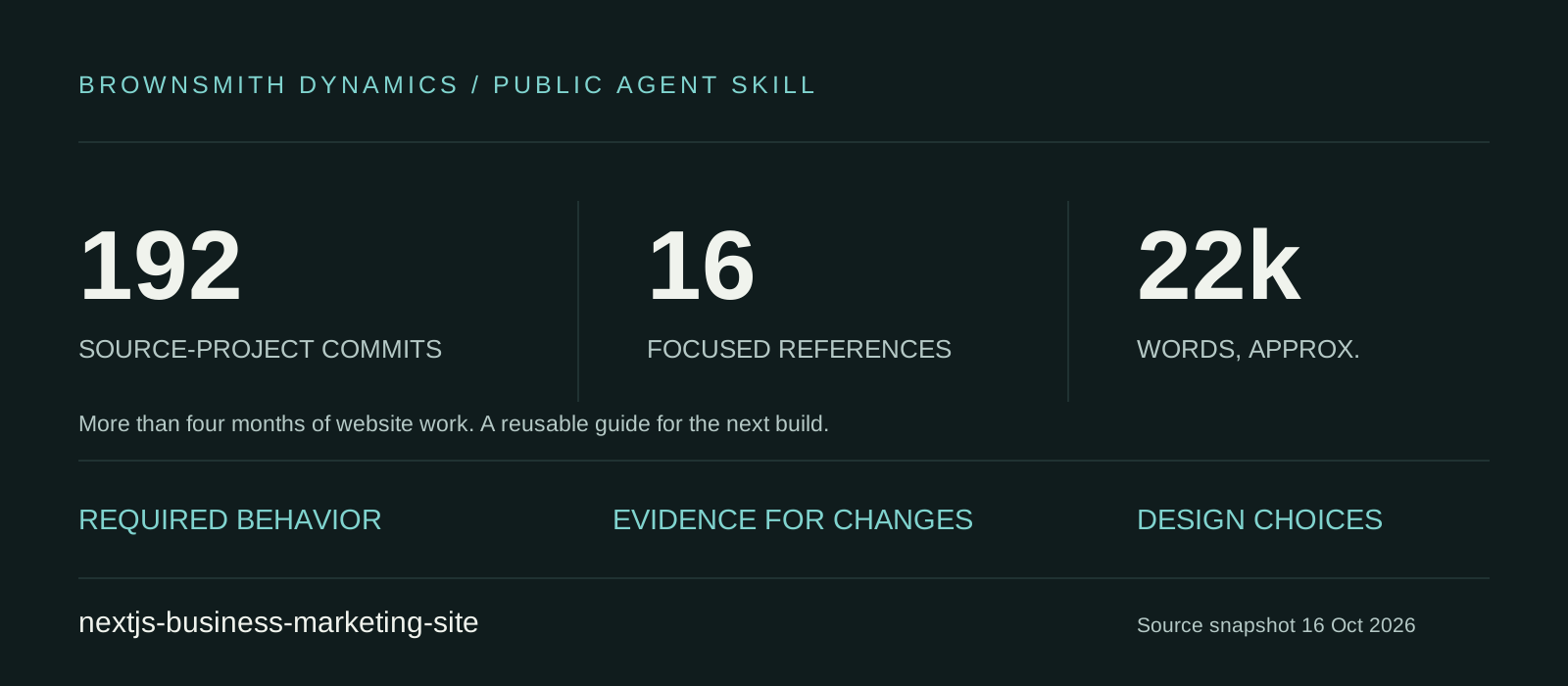
Brownsmith Dynamics shares a Next.js website skill for performance, security, SEO, forms and Git workflows, shaped by 192 commits over four months.
We have published Next.js Business Marketing Site, a reusable skill from Brownsmith Dynamics for people building business websites with AI agents. It brings performance, security, accessibility, SEO, content, forms and Git workflows into one guide. The aim is practical: give the next project a better starting point for decisions we have already had to work through.
Read the Next.js Business Marketing Site skill on GitHubThe source was our own website. At the 16 October 2026 snapshot, the history reachable from its current branch contained 192 commits, beginning on 1 June and covering implementation, content and revisions. We reviewed that work, the conversations around it and the approaches we had reconsidered, then extracted guidance that could travel to another business. The skill became public on 16 October.
Keep the Reasoning That the Next Website Can Use.
The first version of a page leaves a lot of work ahead of it. A menu must fit a short phone screen. A retired URL needs a useful destination or an honest missing-page response. A form must tell the visitor what actually happened to their message. These decisions accumulate as a site grows.
We wanted the reasoning to remain useful after the next redesign. That meant separating requirements, changes that need evidence and choices that belong to the business. Protected credentials and keyboard access belong in the first group. A new cache strategy needs a measured problem. An outlined heading or an animated illustration belongs to the visual brief.
The original contribution is that synthesis of working decisions and established practices. Framework documentation and web standards supply technical authority. The skill connects them to a website workflow while leaving each project to supply its own audience, offer, constraints and identity.
Sixteen References Cover the Decisions Around a Business Site.
The entrypoint and 16 focused references total about 22,000 words. Read the main file first, then open the reference that answers the current question. The complete scope is below.
| Reference | What it helps a team check |
|---|---|
| Project structure and maintenance | Choose maintainable content sources, modules, and dependencies; separate runtime needs from tests and local working files. |
| Strategy and information architecture | Set the audience, visitor task, offer, page purpose, next step, and scope for a useful experiment. |
| Main-site copywriting | Make headings, calls to action, proof, pricing, and factual claims clear and supportable. |
| SEO and discoverability | Align search intent, metadata, canonicals, structured data, crawl rules, feeds, and publication signals. |
| Editorial content | Develop articles and guides with evidence, sources, clear publication states, and distinct visitor value. |
| Design system and responsive layout | Review headers, menus, typography, spacing, phone reflow and accessibility; compare optional GSAP, CSS view animations and sticky layouts. |
| Rendering and performance | Diagnose FCP, LCP, INP and CLS; assess server/client boundaries, dynamic imports, fonts, images, prefetch, caching and build/server costs. |
| Security and privacy | Handle secrets, consent, headers, input limits and abuse; compare Telegram delivery, Google Forms and other intake options. |
| HTTP errors and migrations | Verify 404/410 statuses, methods, representations, redirects, retirement signals, and migrated routes. |
| Agent-facing interfaces | Keep HTML, negotiated Markdown, llms.txt, public data, OpenAPI and any MCP capability accurate and maintainable. |
| Testing and release | Plan unit, contract, HTTP and browser checks; test layout auditors, isolate production output, and define CI, release and rollback. |
| Lessons and evidence | Record why a pattern changed, which evidence informed it, and what that evidence cannot establish. |
| Sources and optional skills | Start from primary framework and standards documentation, then add specialist guidance when the task needs it. |
| Rapid first website | Use a small page, template, hosted form or external booking link when it fits; recognize when the shortcut needs replacing. |
| Decision guide | Find criteria and a deeper reference for recurring implementation and product questions. |
| Workflow and agent collaboration | Research first, delegate bounded work, review shared changes, stage intended Git files, and distinguish commit, push and deployment states. |
Move from the Visitor's Job to Verified Behavior.
Begin with the visitor, their task, the business's real offer, and the next action the site supports. Read the project's contributor instructions, package files, and the documentation for its installed Next.js release. Then inspect the existing routes, content sources, metadata, forms, deployment settings, and known checks before proposing a rewrite.
For each proposed change, name the problem it solves and classify it. Correct statuses, protected credentials, accurate public facts, and operable interactions are requirements when they apply. Rendering changes, caching, page consolidation, and conversion work need project evidence. Style, animation, and vendor choices depend on the brief and trade-offs.
After a bounded change, verify the behavior at the layer where it matters. A source review can show intended logic; it cannot confirm a deployed status code, a form provider's delivery, field performance, or a business result. The checks should match the claim being made.
To try it, give a compatible agent the skill folder and a bounded task. For example: Use nextjs-business-marketing-site to review this service page. Inspect the installed framework and existing implementation. Prioritize correctness, accessibility, contact delivery and measured loading problems. Keep visual preferences separate and explain how each proposed change would be verified. Start with one page before expanding to the whole site.
Look for the Actual Failure Before Choosing the Fix.
A text-led page can have its headline as the Largest Contentful Paint element. Preloading a decorative image may not help. Identify the LCP element, then look at server response, blocking CSS, font loading, and paint before changing resource priority. The right optimization follows the measured delay.
A custom not-found screen can still return HTTP 200 for a missing URL. Request a nonexistent route and inspect the response status and headers. A page with a real replacement may redirect; one without an equivalent resource should return an appropriate not-found or gone response. Google documents how these statuses affect crawling and soft-404 handling.
A Telegram contact form should keep its bot token and destination on the server. Validate the submitted fields, bound request size, set an outbound timeout, and choose abuse controls that suit the deployment. An origin check or honeypot can be useful, but neither authenticates the sender. The success message should match what the service has confirmed.
These examples connect browser performance, HTTP behavior, search, and form security. They show why the skill starts with diagnosis instead of copying a familiar implementation pattern.
Use It as the Primary Workflow, Then Open the Right Specialist Reference.
Use this skill when you need a whole website workflow. It connects work that is often reviewed separately. A performance change can affect when the main message appears. A form choice affects privacy, delivery and the visitor's next step. A release process determines whether any of those changes reaches the public site correctly.
A route change makes the connection concrete. Moving a page can affect the visitor's path, the redirect destination, canonical metadata, internal links, and the sitemap. Updating only the visible page can leave the rest of the site pointing to an old address. The workflow asks the team to inspect the connected surfaces before calling the change finished.
This skill brings those questions into one project workflow, then directs readers to a relevant reference rather than prescribing every answer in the main file. It can sit at the center of a website task while version-specific Next.js documentation and specialist design, accessibility, security, or SEO guidance supply detail when needed.
That also helps a small team keep decisions legible when one person handles several roles. The owner can state the outcome, constraints, and acceptable trade-offs; the person building the site can trace each implementation choice to a requirement or a test. It is a shared working method, not a replacement for business knowledge.
A specialist performance or security reference remains useful for a narrow investigation. This skill provides the surrounding workflow and routes the team to that detail. Its case for adoption is the connected scope, concrete decision criteria and public source that readers can inspect. We have no comparison study establishing it as universally better than other skills.
Read the Work-hour Evidence with Its Original Dates.
An earlier audit of the same website repository covered 1 June through 29 September and counted 157 commits. Retained Codex records for that window total 54.40 summed agent-hours, or 44.42 hours after overlapping runs are merged. These figures describe recorded agent activity across engineering and content work; they are not human working hours, and no human-hour savings were measured.
The later 192-commit count includes setup, merges, imported material, content and implementation through 16 October. It describes the source history rather than 192 independent features. The new evidence file links the public skill snapshot to these separate counts and definitions. Future claims about rankings, conversions or time saved will need their own measurements.
Start with the Business Task and Check the Result.
We are sharing this work through a public repository for developers, small teams and people working on open-source projects. The skill keeps Brownsmith Dynamics' creator credit while giving the receiving project room for its own identity and decisions. Its references link to specialist skills and primary sources without bundling those skills as dependencies.
Open the GitHub folder, choose one recurring website question and follow it through to a verifiable result. That is the contribution we want this release to make: a clearer way to carry useful engineering and editorial experience into the next business website.
Sources and Supporting Material
These references support factual claims in the article. Brownsmith's interpretation and forward-looking analysis remain editorial judgement rather than vendor promises.
- Next.js Business Marketing Site skill (current public version)
- Next.js Business Marketing Site skill (16 October 2026 release)
- Aggregate evidence for the 16 October website-skill snapshot
- Website engineering and Codex usage audit (30 September 2026)
- web.dev: Optimize Largest Contentful Paint
- Google: HTTP status codes and crawler behavior
- Next.js: not-found file convention
- Telegram Bot API: sendMessage
Discovery and BizFlow
Apply This Idea to Your Business.
Find practical improvements that help your team work toward its business goals.
Brownsmith Dynamics supports small, well-funded teams of 1–50 people, including funded startups and established family businesses. BizFlow helps teams get more productive with AI integrations, automation, workflows, and business systems. Discovery helps businesses get more customers through SEO, content, websites, and organic marketing.
Get a Quote
Find practical improvements that help your team work toward its business goals.
Tell Us What You Need
Share your email and a business goal or challenge. We will reply with a practical next step.
Reusable guidance
Browse Brownsmith Dynamics Agent Skills
Explore public skills for business, website, writing, and search workflows.
View agent skillsWebsite planning
Learn How AI-assisted Building Works
Read a practical guide to planning, evaluating, and improving AI-assisted website work.
Read the guide