
What a Technical SEO Audit from [BD] Covers
BD's technical SEO audit finds crawl, speed and structured data issues, helping you prioritise fixes so customers can find, access and use your website.
A technical SEO audit from BD examines whether customers and search engines can reach, read and use your website. We inspect the deployed pages, trace the causes of specific problems and agree which fixes deserve attention first. The result should help an owner commission useful work and give a developer enough evidence to carry it out.
Google Search technical requirementsTechnical SEO covers the foundations beneath your content, including crawl access, rendering, page structure and performance. Google lists three minimum conditions for search eligibility, including "The page has indexable content." A working page also needs an accessible route for Googlebot. Meeting those conditions makes a page eligible for indexing. Google explicitly says indexing is not guaranteed.
For a small service business, that foundation matters because an accurate service explanation is of little use if a crawler receives an error or a customer cannot reach the enquiry form. Our audit connects those technical findings to the pages and actions your business depends on.
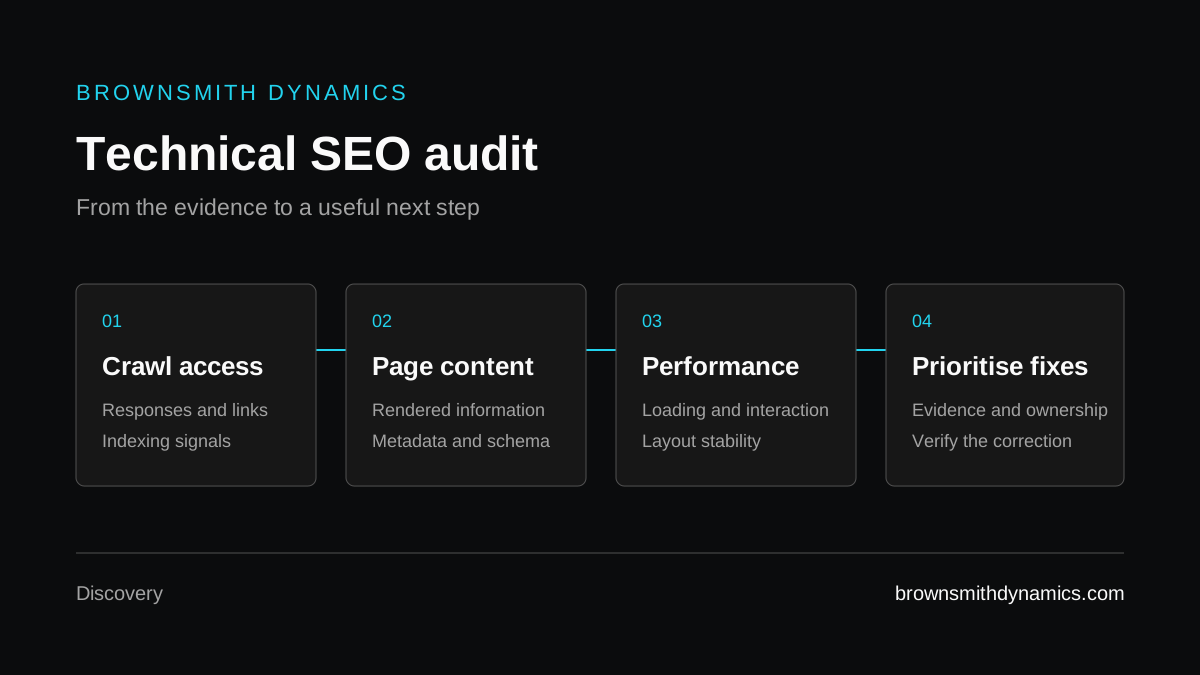
We Start with the Pages Your Business Needs Customers to Find
We review a representative set of pages and journeys, then record the scope. A homepage alone cannot reveal what happens on a service page, a catalogue entry or a contact form. Shared templates deserve attention because one defect can affect many URLs.
The first checks cover HTTP responses, redirects, robots.txt, indexing directives, canonical URLs and the XML sitemap. We look for conflicting signals and broken internal links. A page intended for public discovery should have a clear route from the rest of the site. Private areas and duplicate views need an intentional policy.
Search Console adds evidence about Google's indexed version and reported issues when the business grants access. A public scan can inspect the response we receive today. It cannot establish what every crawler received previously or reveal private Search Console information. We distinguish those findings in the report.
Lighthouse and PageSpeed Insights Answer Different Parts of the Audit
Lighthouse provides repeatable automated checks for performance, accessibility, best practices and selected SEO fundamentals. We use its findings to investigate problems such as excessive JavaScript, oversized images or missing page information. Its SEO score covers a limited set of checks. It does not establish content quality or a ranking position.
PageSpeed Insights combines a Lighthouse lab run with real visitor experience from the Chrome User Experience Report when enough data exists. We record the page, device setting and test conditions. Field data covers a trailing 28-day period and may describe the whole origin rather than the individual URL. A small site may have no field data at all.
We use browser developer tools to inspect requests and rendered content, Search Console for authorised search evidence, and Google's Rich Results Test for supported structured data. When tools report the same issue, we check the underlying evidence before deciding its priority.
We can also review an Is Agentic report when agent access matters to the project. It helps us identify retrieval issues to verify on the site. Its score is not a Google ranking signal, so we treat it as supporting evidence alongside search and browser checks. Our separate Is Agentic article examines a dated report for the BD website.
Read FCP and Core Web Vitals in Context
Performance measurements describe different parts of a visit. First Contentful Paint, or FCP, records the first visible text or image content. A quick first paint can still leave the main content arriving late. Largest Contentful Paint, or LCP, helps expose that delay.
The Core Web Vitals are LCP, Interaction to Next Paint and Cumulative Layout Shift. They cover loading, response to interactions and visual stability. Google's Web Vitals guidance assesses good field performance at the 75th percentile, separately for mobile and desktop. FCP is a useful diagnostic, but it is not a Core Web Vital.
We inspect the cause behind a poor measurement. A late hero image, a slow server response and a long JavaScript task each point to a different fix. The score does not tell you which one to approve.
| Metric | What it describes | Good field threshold |
|---|---|---|
| LCP | When the largest visible content element renders | 2.5 seconds or less |
| INP | How quickly the page responds to interactions | 200 milliseconds or less |
| CLS | Unexpected shifts in the page layout | 0.1 or less |
Performance Matters to Visitors and Search
Google states, "Core Web Vitals are used by our ranking systems." The same page experience guidance explains that good scores do not guarantee top rankings. Relevant, helpful content still matters. We recommend performance work when the evidence points to a problem for visitors or search, rather than simply raising an already strong lab score.
There is also a direct usability reason to fix a slow page. A visitor needs to read the offer and use its contact controls. In a hypothetical service-page example, an image shifts the enquiry button while the page loads. A visitor can miss the next step. Fixing that interruption helps the journey whether or not rankings change.
We compare like-for-like lab runs after a fix and review field evidence over time when it is available. A new deployment does not instantly replace the previous 28 days of real visitor data.
We Check That the Page Explains Itself and Shares Correctly
We check whether a visitor can tell what a page covers, where it sits in the site and what to do next. That includes the main heading, section headings, links, breadcrumb, title, description and canonical URL. Breadcrumb links should lead to real pages.
A service page should explain who the service is for, what the work covers and how to enquire. More keywords or a longer FAQ will not fill a gap in that information. We ask the owner to verify missing business details before adding them.
Open Graph and Twitter Card metadata for X help social platforms build link previews. We check that the title, description and social image load and match the page. These checks improve the shared preview. We do not claim they directly improve Google rankings.
Structured Data Must Describe the Visible Page
For search markup, we normally mean Schema.org vocabulary expressed in JSON-LD. That can identify an organisation, article or breadcrumb trail in a machine-readable form. JSON Schema is a different standard for defining and validating JSON data. It is not another name for search structured data.
We check relevant types and properties, stable identifiers, URLs and agreement with visible content. Article authorship and publication dates should match the byline. Breadcrumb markup should describe the page hierarchy. We check applicable Google requirements as well as syntax, because valid Schema.org markup does not automatically qualify for a Google search feature.
Google's Rich Results Test can assess supported result types. Schema.org validation helps examine the wider vocabulary. Neither result promises that Google will display an enhancement. Unsupported reviews, invented ratings or markup for content a reader cannot see have no place in the audit.
[BD] Implements Fixes in Next.js, React and HTML Sites
We implement fixes on Next.js, other React-based sites and HTML websites when we have access to the relevant code and hosting configuration. WordPress and Wix implementation are outside this service scope.
On Next.js, a fix might involve page metadata, canonical generation, sitemap logic, image delivery or the amount of JavaScript sent to the browser. We inspect the actual response and rendered page before choosing a change. Static generation or server rendering may suit public content, while interactive features can remain in the browser.
Google can render JavaScript, so a React site is not automatically invisible. We check whether its content, links and metadata survive the actual loading and rendering path. If they rely on a failing request or a browser-only interaction, the remedy follows that dependency.
On a plain HTML site, the work may be simpler. We can correct headings and head tags, resize an image, reserve layout space or repair a link and its server redirect. We test the affected journey after the change. A framework migration needs its own justification.
The Report Should Tell You What to Fix First
For each finding, we name the affected URL or template, show the evidence and explain the consequence. We recommend a correction, identify who will implement it and describe how to verify it. A recurring error on a service page should usually come before a minor preview adjustment.
We agree whether the engagement includes the audit alone, selected implementation work or a handoff to your developer. Code access, hosting permissions and Search Console access affect what we can verify. The final scope identifies those needs before work starts.
After implementation, we check the deployed behaviour and retain a comparable record. Technical corrections can remove barriers and improve the visit. Content work, customer demand and an effective enquiry process remain part of the business-development task.
Bring the Page You Need Customers to Reach
If you have a Next.js, React or HTML website, start with the page that matters to your business and the behaviour that concerns you. Our Discovery Technical SEO service can scope a review and prioritise the work. Contact BD with the page and what it should help a customer do, and we will use that purpose to judge the findings.
Sources and Supporting Material
These references support factual claims in the article. Brownsmith's interpretation and forward-looking analysis remain editorial judgement rather than vendor promises.
- Google Search technical requirements
- Chrome for Developers, Introduction to Lighthouse
- Google, About PageSpeed Insights
- Google web.dev, Web Vitals and field thresholds
- Google Search, Understanding page experience
- Google Search, Introduction to structured data
- Google Search, JavaScript SEO basics
- Next.js, Metadata and OG images
- The Open Graph protocol
- JSON Schema, What is JSON Schema
- Is Agentic public website
- Schema.org validator
- Chrome UX Report methodology and data eligibility
- Google web.dev, First Contentful Paint
- Google web.dev, Core Web Vitals thresholds
Discovery and BizFlow
Apply This Idea to Your Business.
Connect your website, search visibility and useful content to a clear enquiry path.
Brownsmith Dynamics supports small, well-funded teams of 1–50 people, including funded startups and established family businesses. Discovery helps with distribution through websites, SEO and content. BizFlow helps teams scale with connected systems and automation.
Get a Quote
Connect your website, search visibility and useful content to a clear enquiry path.
Tell Us What You Need
Share your email and a business goal or challenge. We will reply with a practical next step.
Discovery
Technical SEO Audits and Implementation
Review the audit scope and discuss a Next.js, React or HTML website with BD.
Explore BD Technical SEO