
How [BD] Builds Service Pages That Help Customers Decide
Plan how many pages your website needs with BD. Give each service a clear purpose and avoid repetitive pages that feel spammy or confuse potential customers.
A service company can know its work well and still struggle to decide how many pages its website needs. Put everything on one page and the offer can become difficult to examine. Give every variation a page and the buyer has more routes to sort through. The decision is about how customers choose the work, before it is about a page count.
At BD, we start by writing down the services a customer can commission individually. We then consider useful combinations and the broad needs those services belong to. That gives us three kinds of service page, with a different job for each.
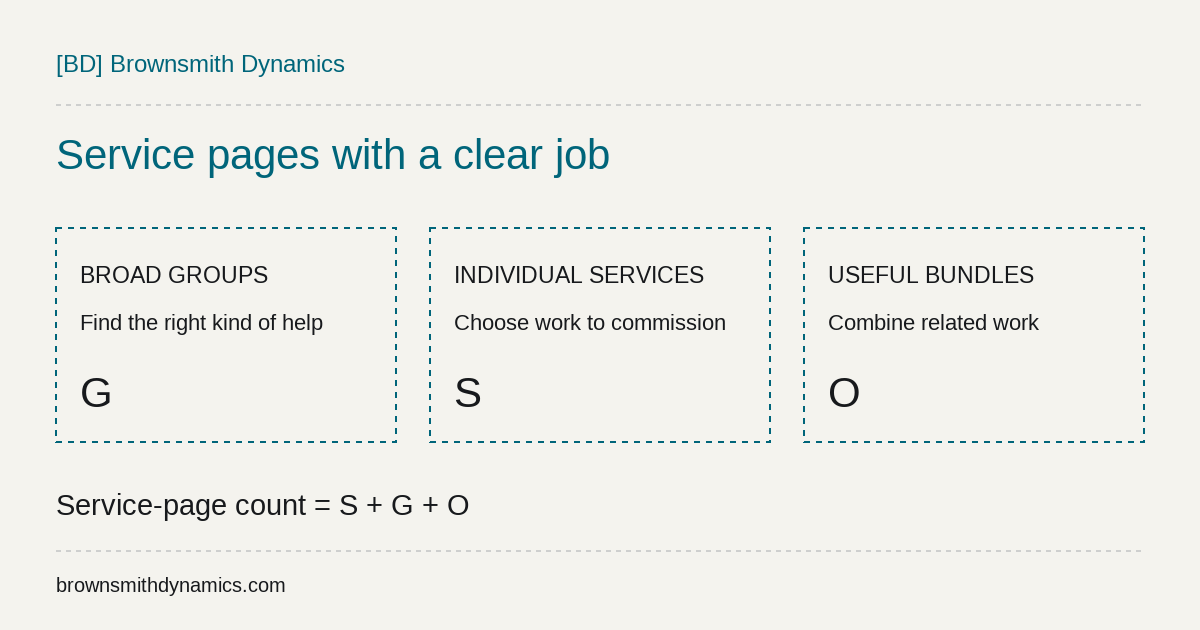
S counts service pages for work customers can commission on its own. G counts broad group pages that help customers find the right service. O counts the optional bundle pages you choose to create. The model is S + G + O and covers service-related pages. The homepage, contact, company, pricing, blog and other supporting pages have separate jobs in the website plan.
Start with Services a Customer Can Buy Individually
S counts distinct services that make sense as individual engagements. We ask whether the business could deliver useful work if the client bought that service alone. That question helps separate a service from a step inside another engagement.
Technical SEO is an example. A business with an existing website can commission an audit without buying a new website from us. Website development and technical SEO therefore have separate service pages. Their relationship belongs in the explanation and the links between them.
Routine tasks inside an engagement belong in its scope. Configuring a heading or uploading an agreed image may be part of website delivery, rather than a separate service a buyer needs to investigate. Giving every task a page would make the visitor navigate the internal work breakdown.
We also distinguish a service from its price options. Several website scopes can sit on one development page when they answer substantially the same buying question. Each candidate for S should be independently useful and have enough distinct scope to explain on its own.
Identify Combinations Customers May Want Together
O is the optional layer for combined offers. We look for services that customers often consider together, such as a website project followed by SEO work. The combination should help a buyer understand a useful engagement, rather than simply collect unrelated items under one price.
A bundle page can explain why the work belongs together, what happens first and what the combined scope includes. Its commercial role is to make a relevant upsell understandable. A customer who arrives for one service can see when adding another would address a genuine need.
It should also remain clear what the customer can commission separately. A website project need not require monthly SEO. The value of the bundle is the useful connection between the work, not making the smaller engagement difficult to buy.
Group the Services Around Recognisable Business Needs
G counts the broad groups that help visitors find the right part of the offer. A group page introduces a need, gives the visitor a reason to explore and points towards the relevant services. It provides orientation before detailed delivery information.
For BD, Discovery and BizFlow are the examples. Discovery brings together websites, SEO, content and channels around customer acquisition. BizFlow groups enquiry management, automation, knowledge assistants and business software around everyday work and capacity.
Those names need plain explanations beside them. A visitor should be able to recognise the problem the group addresses without first learning our terminology. The group page then makes the individual services easier to place in that context.
Use S, G and O to Plan the Service Pages
The baseline is S + G. Add O for bundle pages you choose to create because they answer a distinct buyer question.
Each page needs to help the reader make a different decision. G attracts attention to the relevant family of work. S explains what the individual service includes and how it is delivered. O shows how selected services could work together in a larger engagement.
The order of a customer journey can differ from the order of our planning. We count individual services first to understand the offer. On the website, a visitor may begin with the broad group, move to a service detail and then consider a combination.
| Letter | Page role | Customer decision |
|---|---|---|
| S | Individual service | Understand the work, scope and delivery |
| G | Broad group | Find the part of the offer that fits the need |
| O | Optional combined offer | Assess whether related services belong in one engagement |
A Pricing Page Can Carry the Optional Combinations
A bundle can exist without its own page. If the site has a separate pricing page, list the package there with the services it combines. Pricing sections on existing service or group pages can explain the option too.
That is why O is optional in the page plan. A package may need only a clear comparison row and a short explanation. A dedicated page becomes more useful when the combined work has a distinct audience, sequence or decision that needs room.
A hypothetical launch package might combine website delivery with an initial content programme. Give it a dedicated page when buyers need to see how that work fits together. If the offer only changes price or quantity, show it in the relevant pricing section. A bundle can still be offered without its own page.
The pricing page itself is a supporting page, counted separately when estimating the entire website. We avoid counting its rows as extra pages or counting the same bundle once in pricing and again as another standalone service.
[BD] Uses Broad Groups and Detailed Service Pages
Our current service architecture has eight individual service pages beneath two group pages. Discovery contains website development, technical SEO, content marketing and channel management. BizFlow contains customer enquiry management, workflow automation, AI knowledge assistants, and business software and integrations.
Using the model, that gives us S = 8 and G = 2. The base is ten service-related pages. We can explain useful combinations through those pages and their pricing sections, with no additional dedicated bundle pages required for that base.
This structure has worked for us as a way to organise the BD offer. Each service page covers its own work, and the two group pages connect those services to a business need. Customers can see how the services relate and still begin with one.
That is our experience organising the site. A client's plan should follow its own services, useful groupings and buying decisions.
Give Each Service Page Enough Detail to Support a Decision
An individual service page should help a visitor recognise whether the work fits. We explain the problem, what we deliver and how the engagement proceeds. Relevant examples, the information the client supplies and a clear next step make that explanation practical.
The page should also resolve important scope questions. On our website-development page, a business can understand launch foundations and where ongoing technical SEO or content work may fit. The related service pages explain those engagements in more detail, instead of repeating their whole scope inside the website page.
Links carry that relationship. The group page points to the relevant detail, and the detail points back to its group or across to a useful companion. Descriptive link text gives the visitor a reason to follow it. Google's guidance on crawlable links supports making these routes accessible to search engines too.
Page count becomes a poor target if a new URL only repeats another page with slightly different words. We use the model to organise useful explanations. Search intent and actual customer questions help us decide where one explanation ends and another deserves its own page.
Review the Decisions Before Commissioning the Build
Before estimating the website, write a short purpose beside every proposed page. For an S page, name the work someone can commission. For a G page, name the need that holds the services together. For an O page, explain why the combination needs a dedicated destination.
Read the list as a buyer. Someone who already knows the service should be able to reach its detail directly. Someone who only recognises a business problem should have a useful group page to start from. Both should be able to enquire without reading the whole website.
That exercise gives the designer and writer a concrete brief. It also exposes missing service explanations and optional package pages before they become part of the build. The owner can then choose a sensible first release and expand when another customer decision needs support.
Count the Decisions Your Service Pages Need to Support
Our service-page model starts with S for individually useful services and G for the broad groups that introduce them. O adds optional pages for relevant combinations. Use S + G for the base, and add the bundle pages that have a clear job.
If your service list is ready but the website plan is still unclear, contact BD with the list. Through Discovery website development and content planning, we can help turn it into page purposes, a useful structure and a clearer route to an enquiry.
Sources and Supporting Material
These references support factual claims in the article. Brownsmith's interpretation and forward-looking analysis remain editorial judgement rather than vendor promises.
Discovery and BizFlow
Apply This Idea to Your Business.
Connect your website, search visibility and useful content to a clear enquiry path.
Brownsmith Dynamics supports small, well-funded teams of 1–50 people, including funded startups and established family businesses. Discovery helps with distribution through websites, SEO and content. BizFlow helps teams scale with connected systems and automation.
Get a Quote
Connect your website, search visibility and useful content to a clear enquiry path.
Tell Us What You Need
Share your email and a business goal or challenge. We will reply with a practical next step.
Discovery
Plan a Website Around Your Services
Develop page structure, customer journeys and useful enquiry paths with BD.
Explore Discovery Website DevelopmentContent
Explain the Work on Each Page
Turn accurate business knowledge and customer questions into useful service copy.
Explore Discovery Content Marketing